
Blog, Learn Face Painting
Airbrush Face Painting vs Brush: Which Technique is Best for Your Business in 2026?
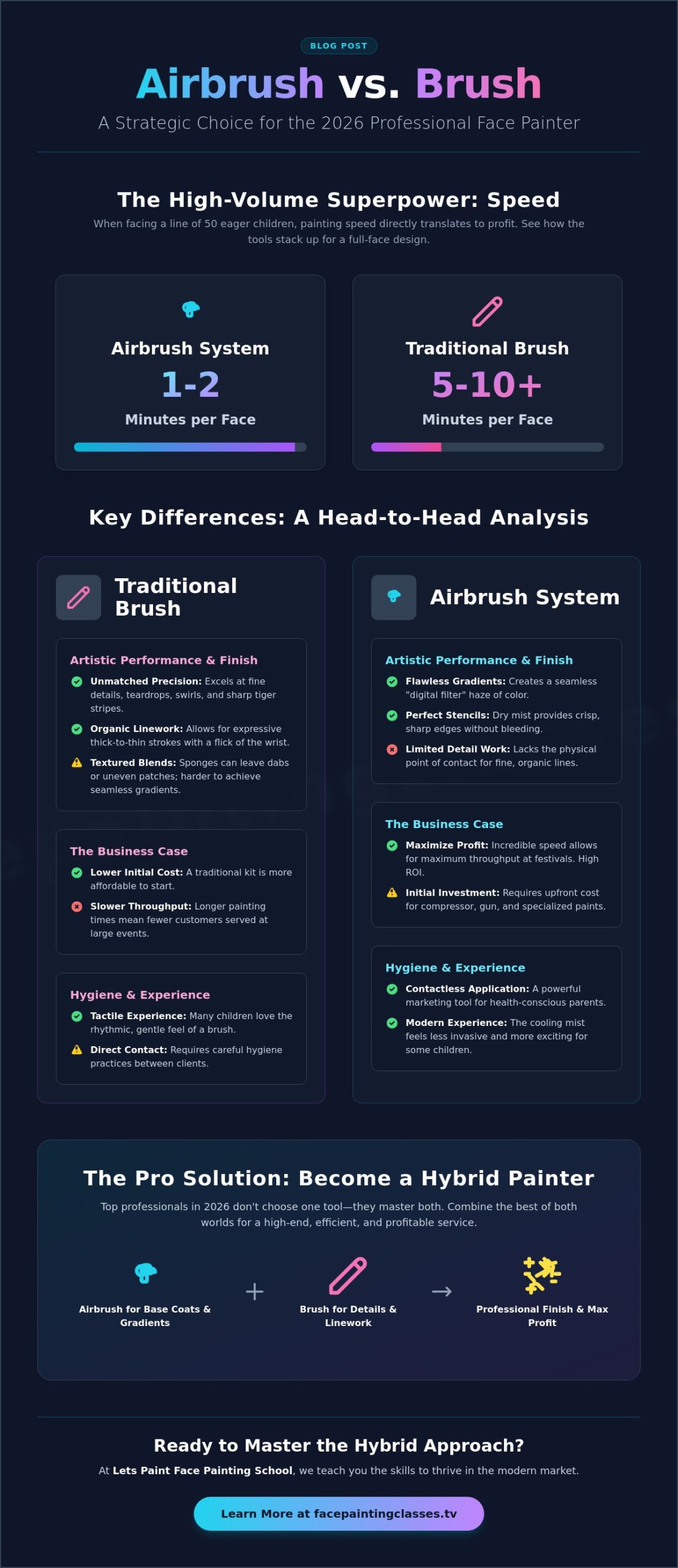
Did you know that an airbrush artist can finish a full-face design in just one to two minutes, while traditional brushwork often takes much longer? When you’re standing in front of a line of fifty eager children at a summer festival, that speed difference feels like a total superpower. Deciding between airbrush face painting vs brush techniques isn’t just about the art; it’s a strategic choice for your growing career in 2026. You’ve likely felt the pressure of a ticking clock or struggled to get that perfectly soft gradient using only a sponge. It’s natural to feel a bit of anxiety about the initial investment or the technical maintenance of a compressor system.
At Lets Paint Face Painting School, we believe every artist deserves to feel both confident and profitable. You’ll discover the critical differences in speed, cost, and finish to help you decide if you should stick with your trusted brushes or embrace the efficiency of an airbrush. We’ll explore how to achieve a professional finish for SFX and stencils while ensuring your turnaround time keeps both clients and event organizers smiling. By the end, you’ll have a clear understanding of the ROI for airbrushing and how it fits your unique creative style.
Key Takeaways
- Master high-volume throughput strategies to maximize your profit potential during busy festival seasons.
- Compare the artistic finishes of airbrush face painting vs brush techniques so you’ll know which method delivers the seamless gradients your clients love.
- Evaluate the initial investment and maintenance needs for airbrush systems versus traditional kits to protect your business’s bottom line.
- Discover why the “contactless” nature of airbrushing is a powerful marketing tool for winning over health-conscious parents in 2026.
- Explore how Lets Paint Face Painting School helps you master a hybrid approach, combining the best of both worlds for a high-end professional finish.
The Evolution of Face Art: Traditional Brush vs. Modern Airbrush
Face painting has transformed from a simple party activity into a sophisticated discipline. Understanding the history and The Evolution of Face Art helps us appreciate how far the industry has come. Traditional brushwork remains the heartbeat of the craft. It involves using water-activated paints, sponges, and pure manual dexterity to create intricate designs. In contrast, airbrushing utilizes a compressor to spray atomized pigment through a specialized gun directly onto the skin. This creates a soft, diffused look that is difficult to replicate with a handheld tool.
As we move through 2026, the industry is seeing the rise of the “Hybrid Painter.” This professional doesn’t choose one over the other; they master both. Understanding the nuances of airbrush face painting vs brush techniques starts with knowing your tools. Beyond the mechanics, the client experience varies significantly. Some children love the tactile, rhythmic feel of a soft brush on their cheeks. Others prefer the cooling, gentle mist of an airbrush, which feels less invasive and often more exciting for those sensitive to touch.
The Artistic Foundation of Traditional Brushes
Every student at Lets Paint Face Painting School begins their journey with brush fundamentals. We believe that hand-eye coordination is the bedrock of artistic expression. Traditional brushes allow you to create organic line work that feels alive. You can achieve thick to thin strokes with a single flick of the wrist. One of the greatest advantages is the ability to mix colors immediately on a petal palette. This manual control is essential for our Line Work Mastery and Sponge & Blending Techniques. It’s about the intimate connection between the artist’s hand and the canvas of the face.
The High-Tech Appeal of Airbrush Systems
Airbrushing has completely revolutionized the speed-painting niche, especially for massive festivals. The science of atomization breaks the paint into tiny droplets, allowing it to sit on the skin like a seamless “second skin.” This creates a professional, high-end finish that looks incredible under 2026 digital cameras. We’ve moved away from the bulky, loud compressors of the past. Today, portable and handheld airbrush units are the standard for the modern professional. As you weigh the pros of airbrush face painting vs brush work, consider how these lightweight systems allow you to move through a crowd with unprecedented ease and efficiency.
Artistic Performance: Finish, Blending, and Detail Work
When you compare the results of airbrush face painting vs brush work, the first thing you’ll notice is the texture. Traditional sponges create a textured blend that works beautifully for organic creatures, but they often leave behind small dabs or uneven patches. The airbrush, however, creates a seamless haze of color that looks like a digital filter. This is particularly effective when working with stencils. While a sponge might bleed under the edges of a plastic stencil, the dry mist of an airbrush produces crisp, sharp edges that resemble professional temporary tattoos. It’s a level of precision that feels almost magical to the client.
Pigment choice also plays a massive role in your performance. Most brush artists use water-activated paints, which are easy to layer but can smudge if the skin gets damp. Airbrush artists often use alcohol-based or hybrid inks that provide incredible durability. Regardless of which you choose, you must ensure your pigments meet the Hygiene and Safety: Navigating Professional Standards set by the FDA to ensure client safety. At Lets Paint Face Painting School, we always prioritize the health of the skin alongside the beauty of the art.
Precision and Line Work: The Brush Advantage
Despite the speed of technology, some things remain timeless. Teardrops, swirls, and intricate tiger stripes require the delicate pressure control that only a high-quality round brush can provide. A brush responds to every micro-movement of your hand, allowing you to taper a line from thick to razor-thin. If you want to sharpen these skills, you can find specific drills in our guide on Mastering Advanced Face Painting Techniques. Airbrushes struggle with these fine, organic details because they lack the physical point of contact needed for tactile precision.
Seamless Gradients and Large Surface Coverage
Speed is where the airbrush truly shines. You can cover an entire face in a base color in under 30 seconds. Imagine creating a Sugar Skull design. An airbrush allows you to create the hollowed-out eye sockets and cheekbones with smooth, realistic shading in a fraction of the time it takes to blend with a sponge. There is also a significant “No-Touch” benefit. For clients who are sensitive to touch or have sensory needs, the cooling mist of the airbrush provides a high-end experience without physical contact. If you are still perfecting your manual blending, our Sponge & Blending Techniques course offers professional secrets for achieving that airbrushed look with traditional tools.
The Business Case: Speed, Kit Costs, and Maintenance
Transitioning from a talented hobbyist to a professional artist means viewing your kit as a business investment. When you weigh the options of airbrush face painting vs brush work, you’re really looking at your potential for hourly earnings. A high-quality set of brushes and sponges is relatively affordable and easy to replace. However, an airbrush system requires a larger upfront investment for the compressor, hoses, and specialized guns. While the initial cost is higher, the long-term payoff comes from your ability to handle massive crowds without breaking a sweat.
Ongoing expenses also differ between the two methods. Traditional artists invest in solid paint cakes that last through hundreds of designs. Airbrush artists rely on liquid pigments that must be thin enough to flow through a needle. Regardless of your choice, you must factor in the cost of high-quality, skin-safe materials that comply with FDA safety regulations for face paint. At Lets Paint Face Painting School, we teach our students that using professional-grade supplies is the first step toward a sustainable career. You also have to consider the “failure point” of your gear. If a brush snaps, you grab another. If a compressor battery dies or a nozzle clogs, your entire operation might halt unless you’ve brought a backup.
Calculating the ROI of an Airbrush System
The real magic happens when you look at your throughput. A traditional painter typically completes 10 to 12 detailed faces per hour. With an airbrush, that number can soar to 20 or even 25 faces because the base layers and stencils apply in seconds. This increased speed directly impacts your booking rate and allows you to charge more for high-volume events. You can even offer “Airbrush Tattoos” as a premium add-on service, which parents often perceive as a more sophisticated option. For a deeper look at how to structure your fees, refer to our Face Painting Pricing Guide.
Maintenance and Portability in the Field
In 2026, the game has changed with the arrival of ultra-portable, battery-powered compressors. You no longer need to hunt for an electrical outlet or trip over long cords. However, these systems require a disciplined cleaning ritual. While you can clean your brushes in five minutes at the end of a gig, an airbrush gun needs a 20-minute deep clean to prevent pigment buildup. You also have to manage the logistics of weight. A brush kit fits in a shoulder bag; a full airbrush system usually requires a rolling case. Consider the noise factor too. Modern 2026 compressors are much quieter than older models, but the subtle hum is still something to manage in intimate, quiet environments like a small birthday party.
Hygiene and Safety: Navigating Professional Standards
Parents in 2026 are more observant than ever. They often look for signs that an artist prioritizes their child’s health before they even step into the line. This is where the choice between airbrush face painting vs brush techniques becomes a powerful marketing tool for your business. Airbrushing offers a unique “contactless” appeal that resonates with health-conscious families. Because the equipment never actually touches the skin, it eliminates many of the anxieties parents have about hygiene at large public events. It’s a visual promise of safety that can set you apart from competitors who only use traditional methods.
Sanitization protocols also differ significantly between these two worlds. For your brushes and sponges, you’ll rely on specialized brush soaps and sanitizing sprays. However, airbrush guns require 70% Isopropyl alcohol to stay clean and functional. This high-proof alcohol doesn’t just clean the equipment; it effectively sanitizes the internal mechanisms between every single client. You also have to consider the safety of “wiggly” clients. When a child suddenly cries or moves, a physical brush near the eye can be a risk. The gentle mist of an airbrush is far safer for restless little ones because there’s no physical point of contact to worry about.
Cross-Contamination Prevention
At Lets Paint Face Painting School, we believe that a beautiful design is only successful if it’s applied safely. One of the biggest hurdles for traditional painters is the “double-dipping” concern. Even with clean water, the act of touching a brush back to a shared paint cake can worry some clients. Airbrushing completely bypasses this issue. The pigment is contained in a closed system and atomized onto the face, ensuring that no cross-contamination occurs. If you’re sticking with brushes, we recommend the following steps:
- Use a “one sponge per child” policy to ensure total cleanliness.
- Change your rinse water frequently, especially after painting around the mouth or nose.
- Use a professional-grade sanitizer spray on your palettes between every gig.
Durability and Sweat-Resistance
If you’re booked for a pool party or a mid-summer festival, the durability of your work is your reputation. Water-activated brush paints are vibrant, but they can run the moment a child starts to sweat or play in the sprinklers. Airbrush pigments, particularly alcohol-based hybrids, are the gold standard for heat and humidity. They dry almost instantly on the skin, making them virtually smudge-proof. When it’s time to go home, you’ll need to educate parents on removal. While brush paint usually washes off with simple soap and water, some airbrush inks require a bit of oil-based remover or liquid soap applied directly to the dry skin. If you want to build a business that parents trust and rave about, mastering these professional standards is essential. You can learn everything you need to know about running a safe, profitable kit in The Face Painting Business Course.
Choosing Your Path: How to Transition to a Pro Kit
Deciding between airbrush face painting vs brush techniques shouldn’t feel like choosing sides. It is about the natural evolution of your artistry. Most successful professionals in 2026 embrace the Hybrid Method. This approach combines the best of both worlds. You use traditional sponges to lay down soft, vibrant bases and then switch to an airbrush for crisp, high-contrast stencils or fine-mist shading. This layered technique provides a “wow” factor that clients rarely see elsewhere. It allows you to maintain the “painterly” feel of a handmade design while benefiting from the sharp, professional edges that only an airbrush can deliver.
If you are just starting, don’t feel pressured to buy a compressor immediately. Mastery takes time. Every student at Lets Paint Face Painting School begins with the basics. We recommend following the Face Painting for Beginners guide to build your muscle memory. Once you feel confident with your hand-eye coordination, you can plan your first upgrade. Your airbrush transition kit should include a gravity-feed airbrush gun, a quiet battery-powered compressor, a cleaning pot, and a set of stencils. By marketing yourself as an “Airbrush Specialist,” you can often justify higher booking rates for corporate clients who value high-speed, high-tech entertainment.
When to Stick with Traditional Brushes
Traditional brushes are your best friends for intimate birthday parties with under 15 children. These events allow for more one-on-one time. You can focus on intricate, custom requests that require fine-art strokes. Brushes are more cost-effective for low-volume gigs since you don’t have to worry about battery life or deep-cleaning a machine between designs. If you love creating organic, detailed characters, check out our Animal Face Painting Designs. These tutorials focus heavily on the brush-led techniques that make every child feel like a unique work of art.
When to Make the Airbrush Leap
The leap to airbrushing is essential when your business scales to corporate events and massive summer festivals. When you need to paint 30 or more people per hour, speed is your primary currency. Airbrushing allows you to maintain a high standard of quality even at a frantic pace. It also opens doors to expanding into waterproof body art and temporary tattoos, which are huge revenue drivers in 2026. You can integrate airbrushing into your workflow without losing your artistic touch. Use it for the “heavy lifting” like large surface coverage and complex patterns, then finish the design with a few signature brush strokes to keep that personal connection with your canvas.
Elevate Your Artistry for the 2026 Season
The choice between airbrush face painting vs brush work isn’t about finding a single winner; it’s about building a versatile toolkit that serves your unique business goals. You’ve seen how brushes offer unmatched artistic control for intimate parties, while airbrush systems provide the speed and hygiene required for massive corporate events. By mastering both, you position yourself as a high-end professional ready for any challenge. It’s an exciting time to be an artist, and the right training makes all the difference.
As you develop your unique professional path, you might look to other successful creative models; for example, Paint Chill Co demonstrates how to effectively combine artistry with social entertainment to build a thriving business.
Success in this vibrant field requires more than just raw talent. You don’t have to travel this transformative path alone. At Lets Paint Face Painting School, we’ve built a supportive community of over 10,000 artists who are all striving for excellence. Whether you want to perfect your line work or master the technical nuances of an airbrush compressor, we have the resources to help you shine.
As you plan your long-term business strategy, you might also explore Digital Course and Membership Fees to see how digital learning systems can help you build a sustainable income stream online.
Start your journey with The Ultimate Face Painting Course at Lets Paint Face Painting School today! You’ll gain access to step-by-step video tutorials for both techniques, along with essential business training on ROI and pricing. Your creative potential is limitless!
Frequently Asked Questions
Is airbrush face painting faster than brush painting?
Airbrushing is significantly faster than traditional brushwork, especially when you are managing large crowds at festivals. While a brush artist might take several minutes to blend a complex base, an airbrush can achieve a seamless coat in under 30 seconds. This rapid application allows you to increase your hourly throughput and serve more guests. It is the ultimate tool for high-volume environments where speed is your primary goal.
Do I need a license to use an airbrush for face painting?
You generally don’t need a specific license just to operate an airbrush, but you must stay informed about your local business and health regulations. Some jurisdictions require a cosmetology license for any professional makeup application, regardless of the tools used. It’s your responsibility to check with your local government or health department. Staying compliant ensures that your business remains professional and protected as you grow.
What is the best airbrush makeup for sensitive skin?
Water-based or hybrid airbrush pigments are typically the best choice for clients with sensitive skin. These formulas feel lighter than alcohol-based inks and are less likely to cause a reaction or irritation. Always look for products that are clearly labeled as FDA-compliant for cosmetic use. At Lets Paint Face Painting School, we encourage artists to keep a variety of formulas to safely accommodate every child’s unique skin needs.
Can I use regular face paint in an airbrush gun?
You cannot use regular cake or cream face paint in an airbrush gun because the thick consistency will cause immediate clogs. These tools require specialized liquid pigments that have been finely filtered for atomization. Even if you try to thin down traditional paint, the particles are often too large for the tiny nozzle. Using the wrong product can damage your expensive equipment and ruin your workflow during a gig.
Is airbrush face painting more expensive for the client?
Many professionals charge a premium for airbrush services due to the high equipment overhead and the specialized skill required. When comparing airbrush face painting vs brush services, clients often perceive the airbrush as a high-end, “tech” experience. This allows you to set higher hourly rates for corporate bookings where a professional, high-volume setup is a major selling point for the event organizer.
How do I clean an airbrush gun between different children?
Cleaning an airbrush gun between children involves a quick flush with a specialized cleaning solution or 70% Isopropyl alcohol. You simply spray the cleaner through the gun into a dump jar until the spray runs clear. This process only takes a few seconds and ensures that no pigment from the previous design remains. It’s a vital step for maintaining the hygiene standards we teach at Lets Paint Face Painting School.
Which is better for beginners: airbrush or brush?
Traditional brushes and sponges are almost always better for absolute beginners because they teach you the fundamentals of pressure and paint consistency. Learning the basic mechanics of hand-eye coordination is much easier with a handheld tool. Once you’ve mastered basic designs, you can then explore airbrush face painting vs brush techniques to decide if the equipment investment and maintenance fit your long-term professional business goals.
Is airbrush face paint waterproof?
Some airbrush paints are waterproof, but it depends entirely on whether the pigment is alcohol-based or water-based. Alcohol-based formulas are designed to withstand water, sweat, and heavy friction, making them ideal for pool parties or summer heat. Water-based airbrush paints, however, will wash away just like traditional cake paints. Always check the manufacturer’s label to ensure you’re using the right product for your specific environment and client needs.
