
Blog, Learn Face Painting
Face Painting Insurance Requirements Australia: The 2026 Professional Guide
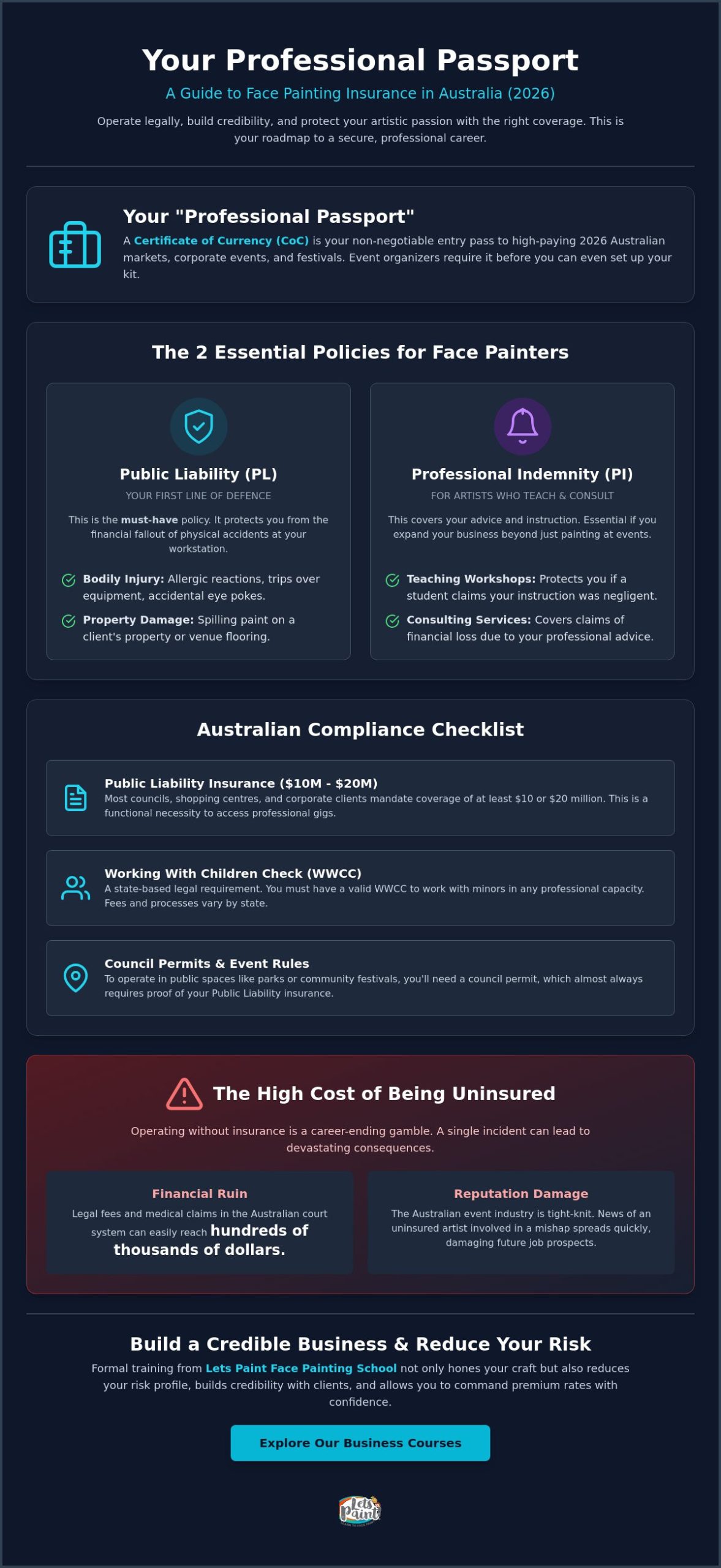
Your insurance policy is actually your “Professional Passport,” the most important document you’ll carry to any Australian market or corporate event. While your artistic talent is the soul of your work, understanding the face painting insurance requirements Australia demands is the foundation that keeps your creative journey safe and sustainable. It’s completely normal to feel a bit overwhelmed by the technicalities of liability. You might worry about the cost of premiums for part-time work or fear the legal fallout of a rare allergic reaction.
At Lets Paint Face Painting School, we believe that professional knowledge empowers your artistic freedom. You deserve to step onto every gig with the confidence that you’re fully protected. This 2026 guide breaks down the essential policies you need to operate legally and build instant credibility with high-paying clients. We’ll walk you through a clear checklist of required coverage, explain state-specific Working With Children Check fees, and demystify complex council permit regulations. By the end of this article, you’ll have a clear roadmap to turn your passion into a secure, professional career.
Key Takeaways
- Discover why a Certificate of Currency is considered your “Professional Passport” for accessing high-end 2026 Australian event opportunities.
- Learn to distinguish between Public Liability for physical mishaps and Professional Indemnity for those expanding into teaching or consulting roles.
- Navigate the specific face painting insurance requirements Australia mandates to ensure your policy stays valid alongside state-based Working with Children Checks.
- Gain a clear checklist for evaluating providers like Duck for Cover or IICT to find the most cost-effective coverage for your specific business model.
- Understand how formal training through Lets Paint Face Painting School reduces your risk profile and allows you to command premium rates with confidence.
Understanding Face Painting Insurance Requirements in Australia
Think of your insurance policy as the invisible shield surrounding your brushes and sponges. In the Australian event industry, face painting insurance is a specialized branch of Public Liability Insurance designed to protect you from the unexpected. While we all strive for perfection, accidents happen. A child might have a rare allergic reaction to a specific pigment, or a stray elbow could lead to an accidental eye poke. These “one-in-a-million” moments are exactly why professional coverage exists. It transforms a potential career-ending mistake into a manageable professional hurdle.
By 2026, the landscape for artists has become clearly defined. Event organisers across Australia now require a Certificate of Currency (CoC) before you even begin to unpack your kit. This document proves your policy is active and meets the specific coverage limits required for the venue. At Lets Paint Face Painting School, we teach our students that the transition from a hobbyist to a professional begins with this paperwork. A hobbyist might paint for friends at no cost, but once you accept payment and market your services, you’ve entered the professional sphere. This status change means you’re responsible for your own risk management and tax obligations, especially if you’re approaching the $75,000 GST registration threshold.
Is Insurance Legally Required in Australia?
There is no specific federal law that forces a face painter to hold insurance. However, you’ll find that commercial “gatekeepers” make it a functional necessity. Most Australian local councils require proof of 10 or 20 million dollars in coverage before they’ll approve a permit for a public park or community festival. Similarly, shopping centres and corporate clients have strict safety protocols. They simply won’t hire an artist who cannot produce a valid CoC. Meeting the face painting insurance requirements Australia demands is the only way to access these high-paying, professional opportunities.
The Cost of Not Being Insured
Operating without insurance is a gamble that rarely pays off. The Australian court system involves significant legal fees and medical claim costs that can easily reach hundreds of thousands of dollars. Beyond the financial ruin, your reputation is at stake. The Australian event industry is tight-knit; news of an uninsured artist involved in a mishap spreads quickly among coordinators and agents. Public Liability is the coverage that protects your business if a child accidentally trips over your equipment or suffers an injury while at your workstation. Investing in protection is an investment in your peace of mind and your long-term creative success.
Public Liability vs. Professional Indemnity: What You Need
Choosing between different types of coverage can feel like picking the right brush for a complex design. You need the right tool for the specific job. Understanding the face painting insurance requirements Australia mandates means recognizing that your business needs protection from two distinct angles. Public Liability is your broad stroke; it covers the physical world where your kit and your clients interact. Professional Indemnity is your fine detail brush; it covers the intangible world of your expertise and instruction. Together, they create a bulletproof foundation for your creative career.
When you research business insurance requirements, you’ll see that PL is the starting point for most Australian sole traders. However, a professional artist often wears many hats. You might start by painting faces at a local market, but soon you’re sharing your wisdom with others. As your business grows, the way you protect it must evolve too. If you’re ready to master the logistics of your craft, our Face Painting Business Course offers deep insights into building a secure, professional foundation.
Public Liability: Your First Line of Defence
Public Liability (PL) is the “must-have” policy for every artist. It’s designed to protect you against the financial fallout of physical accidents. This includes property damage, such as accidentally spilling a bottle of vibrant pigment on a client’s expensive designer rug. More importantly, it covers bodily injury. If a child has a severe, unexpected reaction to a specific pigment, your PL policy handles the legal and medical complexities. In 2026, a $10 million or $20 million AUD cover has become the standard requirement for most Australian festivals and shopping centres. Without this level of protection, you’ll find many professional doors remain closed to you.
Professional Indemnity: When You Become the Expert
Professional Indemnity (PI) becomes crucial as you transition from practitioner to mentor. If you begin teaching workshops through Lets Paint Face Painting School or providing professional consultations on hygiene and kit setup, you’re offering expert advice. PI protects you if a student or client claims your advice was negligent. For example, if a student follows your hygiene protocol but later faces a legal claim from a client, they might look to your instruction as the cause. PI provides the legal support to defend your professional reputation. You should watch for common exclusions in standard policies, such as the use of non-cosmetic grade glitters or specific high-risk activities like airbrushing, which may require additional disclosures to your broker.
Australian Compliance: WWCC, Council Permits, and Event Rules
Professionalism in the Australian arts scene is a mosaic of different legal requirements. While your insurance policy is a massive piece of that puzzle, it doesn’t exist in a vacuum. To truly satisfy the face painting insurance requirements Australia demands for 2026, you must understand how your coverage interacts with state based safety checks and local government rules. This compliance ecosystem ensures that you, the event organiser, and the families you serve are all operating within a secure, trusted framework. At Lets Paint Face Painting School, we encourage our students to view these regulations not as hurdles, but as the hallmarks of a high level career.
The Working with Children Check (WWCC) Link
Most Australian insurers now view a valid Working with Children Check as a non negotiable prerequisite for your policy. If a claim arises from an incident involving a minor and you don’t hold a current check, your insurer could potentially void your coverage. As of June 2026, fees for these checks vary significantly across the country. In New South Wales, the fee is $107, though it’s set to increase to $112 on July 1, 2026. In Victoria, the fee will reach $139.20 on that same date. Queensland artists pay $104.70 for their Blue Card, while Western Australian checks cost $87.00. Presenting your insurance and WWCC together as a “Trust Package” via the 2026 digital wallet integration makes you an irresistible choice for safety conscious parents.
Navigating Local Council Requirements
Local councils are the primary “gatekeepers” for public spaces. If you plan to paint at a local park or a community festival, you’ll likely need a permit. Councils often categorize face painting under “Busking” or “Low Impact” event permits. A critical detail many artists miss is that your insurance certificate must explicitly state “Face Painting” as a covered activity. If your policy is too generic, a council officer may reject your permit application. Additionally, most Australian councils require Product Liability to be bundled with your Public Liability. This specifically covers you if a client has a reaction to the paints you use. For a detailed breakdown of permit applications, our guide on How to Start a Face Painting Business provides a comprehensive checklist to keep your admin as smooth as your line work. Understanding these nuances early on allows you to focus on the joy of creation rather than the stress of paperwork.
How to Choose the Right Insurance Provider in 2026
Selecting the right insurance provider is a pivotal step in your professional journey. It’s about more than just finding the lowest price; it’s about finding a partner that understands the specific risks of our colourful industry. When you evaluate options to meet the face painting insurance requirements Australia demands, you’ll find that 2026 offers more digital-first, tailored solutions than ever before. Choosing wisely ensures that your “Professional Passport” is valid, respected, and ready for any gig that comes your way. If you want to ensure your business side is as polished as your brushwork, consider enrolling in The Face Painting Business Course to master these professional standards.
Before you sign a policy, you must ask potential brokers about their specific classifications. Many Australian face painters fall into a “Market Stall” category, which is perfect for fixed locations. However, if you travel to private parties or corporate offices, you may need a “Mobile Professional” classification. You should also compare annual premiums against short-term “per event” coverage. While many small businesses in this category pay between $400 to $1,500 annually, those who only work a few weekends a year might find short-term options more cost-effective. However, the peace of mind that comes with a year-round policy is often worth the investment for aspiring professionals.
Top Australian Insurance Options for Artists
In 2026, several providers stand out for their commitment to the arts. Duck for Cover remains an industry favourite for performers. As of current 2026 rates, face painters fall under “Category 2,” with public liability cover costing just $59 for performers whose activities fit this low-risk profile. This is a remarkably accessible entry point for beginners. The International Institute for Complementary Therapists (IICT) is another excellent choice, especially if you combine face painting with other modalities like glitter bar services or artistic workshops. Finally, specialized brokers like Aon provide robust small business packages that are highly regarded by shopping centres and large scale event organisers.
What to Look for in the Fine Print
The Product Disclosure Statement (PDS) is where the real details live. You must check the “Excess” amount, which is the out-of-pocket cost you’ll pay if you ever need to make a claim. Some low-premium policies have high excesses that can sting when you’re least prepared. Additionally, verify if activities like glitter tattoos or henna are included. These often require a separate “rider” or add-on to your standard policy. Most importantly, look for a “Hygiene Warranty.” This clause often mandates specific professional standards to keep your coverage active, such as:
- Using only professional-grade, cosmetic-quality face paints that comply with Australian Standards.
- Maintaining a “one sponge per child” protocol to prevent cross-contamination.
- Using clean, potable water and changing it frequently throughout your shift.
- Ensuring all brushes are sanitized between clients using industry-approved solutions.
At Lets Paint Face Painting School, we emphasize that these hygiene standards are not just about insurance; they are the foundation of your professional reputation and the safety of the children in your care.
Building a Credible Business with Lets Paint Face Painting School
Your journey from a casual artist to a high level professional is a transformative path that involves both creative flair and structural discipline. When you invest in formal training, you aren’t just learning to paint; you’re actively reducing your business risk profile. Insurers and event organisers look for artists who demonstrate a commitment to excellence and safety. By mastering the face painting insurance requirements Australia expects, you position yourself as a serious professional deserving of high level bookings. At Lets Paint Face Painting School, we guide you through this transition, ensuring your passion is backed by professional authority.
From Hobbyist to Insured Professional
Stepping into the world of business requires a psychological shift. It’s the moment you stop saying “I just paint faces” and start saying “I run a professional entertainment business.” The Face Painting Business Course is designed specifically to help you navigate the logistics of legal setup, from ABN registration to understanding the fine print of your policy. We encourage all our students to view insurance as a strategic business investment. It provides the safety net you need to explore your creative potential without the shadow of legal worry hanging over your workstation.
Mastering Hygiene to Prevent Claims
The technical skills you learn, such as Line Work Mastery, are deeply connected to physical safety. Precise control over your tools reduces the risk of accidental contact with a child’s eyes or mouth. Beyond the brush, your hygiene protocol is your strongest defence against insurance claims. Following the structured frameworks in our Face Painting for Beginners Guide ensures you prevent kit contamination and maintain the standards insurers demand. Are you ready to bridge the gap between raw talent and professional success? Join The Ultimate Face Painting Course at Lets Paint Face Painting School today!
Secure Your Creative Future Today
You now have the roadmap to navigate the technical side of your artistry with confidence. By understanding how a Certificate of Currency opens doors to premium venues and why your Public Liability must align with state-specific safety checks, you’ve already separated yourself from the crowd. These face painting insurance requirements Australia enforces are simply the building blocks of a sustainable, high-level career. You’ve learned that protection isn’t just a cost; it’s a strategic investment in your professional reputation.
Don’t let the administrative side of your passion hold you back from the success you deserve. At Lets Paint Face Painting School, we’re here to guide you through every brushstroke and business decision. Our training provides step-by-step guidance on business legalities and includes comprehensive hygiene and safety modules to keep your kit pristine. Plus, you’ll gain access to a global community of professional artists who are just as passionate about excellence as you are.
Launch Your Professional Career with the Ultimate Face Painting Course and turn your artistic dreams into a protected, profitable reality. Your journey toward professional mastery is just beginning, and we’re so excited to see your art shine in the world.
Frequently Asked Questions
Is face painting insurance expensive in Australia?
Professional coverage is remarkably affordable for most sole traders. According to verified 2026 research, public liability insurance for lower risk artists can start from around $39 per month. Specialized performer rates for Category 2 activities are approximately $59. It is a small, manageable investment that provides the essential foundation for your creative business and allows you to book higher paying gigs with confidence.
Does my home and contents insurance cover my face painting business?
Standard residential policies almost never cover commercial activities or professional liability. You need a dedicated business policy to protect your equipment and legal interests while you are working at events or in clients’ homes. If you operate from a home studio, it is vital to inform your current provider to ensure your residential coverage remains valid while you build your professional career.
Do I need a separate policy for glitter tattoos or hair braiding?
You usually don’t need a completely separate policy, but you must ensure these activities are explicitly listed on your insurance schedule. Some standard face painting insurance requirements Australia providers have include these by default, while others require a specific add-on. Always check your Product Disclosure Statement to confirm every service you offer is fully protected under your current agreement.
What is a Certificate of Currency and how do I get one?
A Certificate of Currency is a formal document issued by your insurer that proves your policy is active and valid. It serves as your “professional passport” for 2026 event organisers, detailing your coverage limits and expiry date. Most Australian insurers allow you to download this document instantly from their online portal once you have completed your application and paid your premium.
Can I get insurance if I am only 16 years old and starting out?
Yes, many Australian insurance providers offer coverage to young artists, though a parent or legal guardian may need to co-sign the policy. Starting your professional journey early is a fantastic way to build a long term career. At Lets Paint Face Painting School, we encourage students of all ages to embrace these professional standards to ensure their artistic journey is safe and successful.
Do Australian councils require a specific amount of public liability cover?
Most Australian local councils mandate a minimum of $10 million or $20 million in public liability coverage for any public space or community event. This has become the universal standard for 2026. If your policy only provides $5 million in cover, you will likely find yourself ineligible for lucrative council run festivals, markets, and public park bookings across the country.
What happens if a child has an allergic reaction to the paint?
If an unexpected reaction occurs, your Product Liability insurance provides the legal and financial protection needed to manage the claim. This is exactly why using high quality, cosmetic grade paints is a professional requirement. Your insurance acts as a vital safety net, ensuring that a rare accident doesn’t lead to financial ruin or end your promising career in the arts.
Is insurance required if I am volunteering for a charity event?
Yes, almost all reputable charities and non profit organisations require volunteers to hold their own face painting insurance requirements Australia compliant policies. Even when you are donating your time, you are still responsible for the safety of the children you paint. Holding your own coverage ensures you remain protected and professional, regardless of whether the gig is a paid booking or a community contribution.
